

Most people struggle with how to save money from salary every month not because their income is low but because they do not follow a fixed system. Salary comes in and gets spent on rent, bills, food, and small daily expenses, leaving nothing by the end of the month. The simplest way to fix this is to save first and spend later. As soon as your salary is credited, transfer 10–20% of it into a separate savings account before making any expenses. This method ensures that saving becomes a priority instead of an afterthought, and even a small amount like ₹2,000 per month can grow into ₹24,000 in a year.
To save money from salary every month, follow the 50/30/20 rule, where 50% of your income goes to essential expenses, 30% to personal spending, and 20% is saved or invested. Automating this transfer through your bank helps maintain consistency and removes the need for willpower, making it easier to build a long-term saving habit.
Table of Contents
Why You Can’t Save Money from Salary Every Month

Most people struggle with how to save money from salary every month not because their income is low, but Most people struggle with how to save money from salary every month not because their income is low, but because there is no structured way of managing money.
The real problem is how money gets spent throughout the month:
- Saving whatever is left at the end of the month — which usually means nothing is saved
- EMI overload — phone loan, bike loan, personal loan, and BNPL reducing usable income
- Daily micro-spends — food delivery, coffee, and impulse UPI payments adding up to ₹4,000–₹6,000 per month
- Unused subscriptions — OTT platforms and apps renewing automatically without notice
- No expense tracking — not knowing where a significant part of income is going
- Lifestyle inflation — income increases, but spending increases even faster
These patterns make it difficult to save money from salary every month consistently. Once you identify and control these money leaks, saving becomes much easier and predictable.
According to a Reserve Bank of India report on household savings, better financial awareness and expense tracking can significantly improve saving habits and reduce unnecessary spending.
The 50/30/20 Rule to Save Money from Salary Every Month
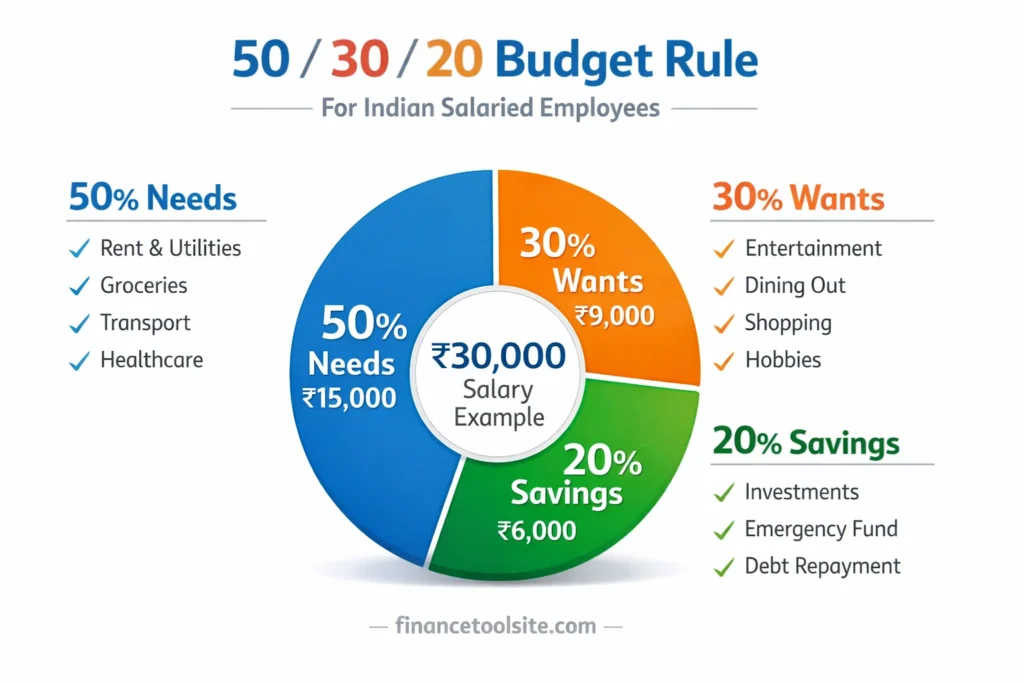
If you’ve never used a budget before, this is the best place to start. Simple, proven, and works on any salary.
| Category | % of Salary | What Belongs Here |
| Needs (Must-Haves) | 50% | Rent, groceries, electricity, transport, EMIs, medicine |
| Wants (Good-to-Haves) | 30% | Dining out, OTT apps, weekend outings, shopping |
| Savings & Investment | 20% | Emergency fund, SIP, PPF, FD — transfer on Day 1 of salary |
For a ₹30,000 salary: ₹15,000 for needs. ₹9,000 for wants. ₹6,000 straight into savings. That’s ₹72,000 in 12 months — without a single salary hike.
If 20% feels tight right now, start with 10% and increase by 2% every 3 months. The habit matters more than the amount. Want to see your exact breakdown? Use this free calculator:
Real Monthly Savings Plan — ₹20,000 and ₹30,000 Salary
If Your Salary Is ₹20,000/Month
| Category | Amount | Breakdown |
| Needs (50%) | ₹10,000 | Rent ₹5,000 | Groceries ₹2,500 | Travel ₹1,500 | Bills ₹1,000 |
| Wants (30%) | ₹6,000 | Mobile recharge, OTT, one outing, small purchases |
| Savings (20%) | ₹4,000 | Auto-transfer to savings account on salary day — non-negotiable |
Result: ₹4,000 × 12 = ₹48,000 saved in one year. That’s real money — from one simple habit.
If Your Salary Is ₹30,000/Month
| Category | Amount | Breakdown |
| Needs (50%) | ₹15,000 | Rent ₹8,000 | Groceries ₹3,500 | Travel ₹2,000 | Bills ₹1,500 |
| Wants (30%) | ₹9,000 | Dining, entertainment, shopping, weekend plans |
| Savings (20%) | ₹6,000 | ₹3,000 into SIP + ₹3,000 into emergency fund |
Result: ₹6,000 × 12 = ₹72,000 in year one. Put that in a SIP at 12% return over 5 years and it grows past ₹5.5 lakh.
See how your savings grow over time:
Step-by-Step Plan to Start Saving from Next Salary
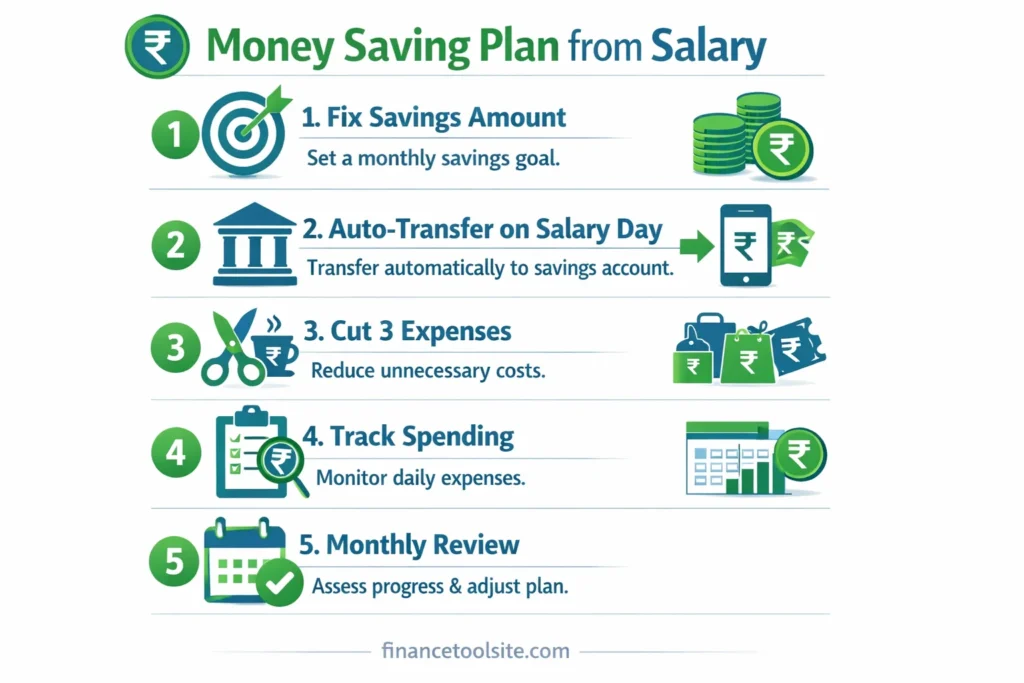
Follow this plan on your very next salary day. No complicated steps, no apps to learn — just 5 actions:
- Decide your savings amount right now — even ₹1,000 is fine. Write it down. This number is fixed.
- Set up a standing instruction or auto-transfer in your bank app to move that amount on salary day + 1. If it stays in your account, it will get spent.
- Find 3 expenses to cut this month — one unused subscription, reduce food delivery by 2 days a week, skip one impulse buy. That alone frees ₹1,500–₹3,000.
- Track every spend for 30 days — use Walnut, Money Manager, or even a WhatsApp note to yourself. Many people also use simple online tools to track their monthly savings and expenses more accurately.
- On the last day of the month, spend 10 minutes reviewing: Did I hit my target? Where did I overspend? What will I adjust next month?
That’s the full system. Run it for 3 months and it becomes automatic — you stop noticing the money leaving.
Pros and Cons of This Monthly Salary Saving Strategy
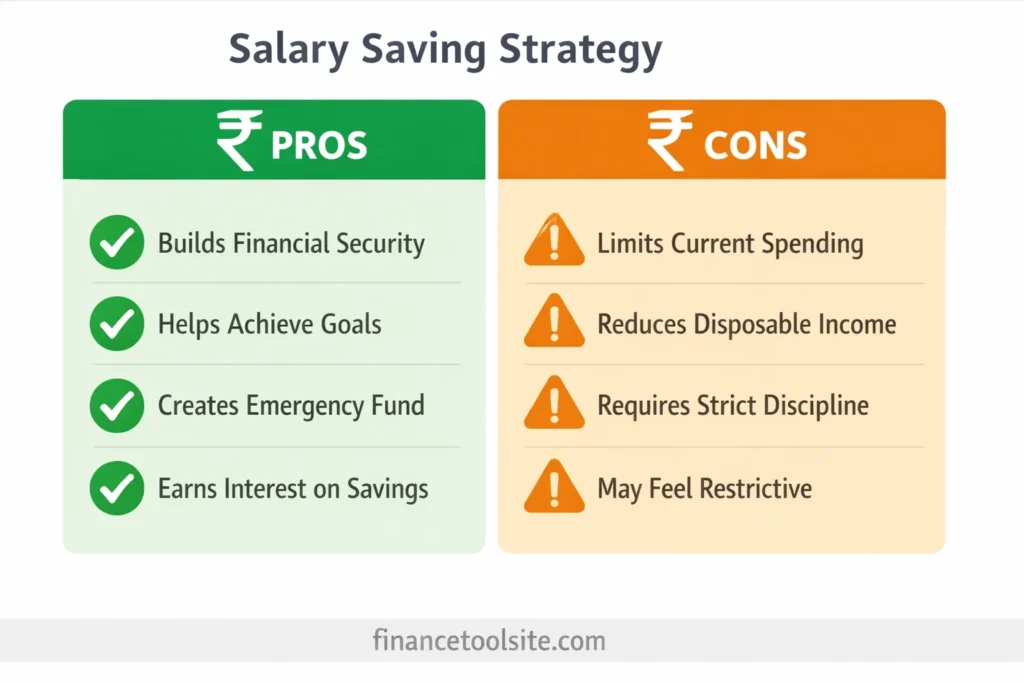
Every saving strategy has trade-offs. Here’s what you should know before you start:
| ✅ Pros | ⚠️ Cons |
| Works on any income — even ₹10,000/month | Needs 1–2 months of adjustment to feel comfortable |
| Automation removes the need for willpower | Requires a separate savings account to work properly |
| Even small amounts compound meaningfully over years | Unexpected expenses can temporarily disrupt the plan |
| Builds real investing habits alongside saving | 20% savings target may feel tight on very low salaries initially |
| Reduces financial anxiety and month-end stress | Needs a monthly 10-minute review — not purely hands-off |
These cons are real, but none of them are reasons to delay. Most of them solve themselves after the first two months.
Use This Free Calculator to Build Your Saving Plan
| Free Tool: Money Management Calculator. Enter your salary and monthly expenses. The calculator instantly shows your ideal savings amount, spending breakdown by category, and where you’re leaking money: |
Takes 2 minutes. No sign-up. Just enter your numbers and get a clear picture.
More tools that help:
→ SIP Calculator — see how ₹500/month grows over 10 years
→ Loan EMI Calculator — check if your EMIs are eating too much salary
Best Salary Saving Tips for Indian Employees
These are practical, India-specific tips — not generic advice copied from foreign finance blogs:
- Start a SIP with just ₹500/month via Groww or Zerodha. At 12% return over 10 years, ₹500/month becomes ₹1.16 lakh.
- Open a PPF account — ₹500 minimum, fully tax-free returns, Section 80C deduction. Best safe long-term savings vehicle in India.
- Apply the 24-hour rule for any non-essential purchase above ₹500. Most urges disappear on their own within a few hours.
- Buy monthly groceries from D-Mart or wholesale stores — saves 15–20% compared to daily neighbourhood shops.
- Delete food delivery apps for one month and cook at home. Most people save ₹2,000–₹4,000 from this one change alone.
- Cancel subscriptions you use less than twice a week. Audit your bank statement — there are usually 2–4 silent leaks.
- Build an emergency fund (3–6 months expenses) before you invest anywhere else. Without it, you’ll break investments at the worst time.
External reference: According to the Reserve Bank of India, Indian households that maintain liquid emergency savings show significantly lower dependence on high-interest debt. Source: rbi.org.in
Common Mistakes That Destroy Your Savings Every Month
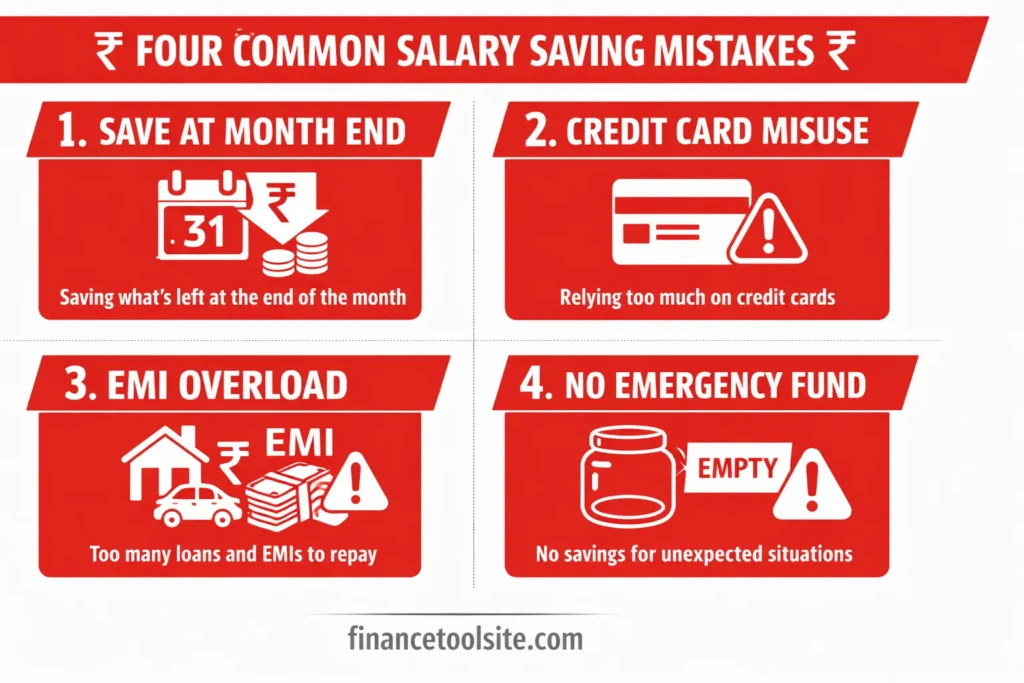
Mistake 1: Saving Whatever Is Left at Month-End
This is the single most common mistake. There is never anything left at month-end. Expenses expand to fill the available money — always. Save first on salary day. Spend the rest.
Mistake 2: Using Credit Cards Without Paying Full Balance
Credit cards are fine for rewards — but only if you pay the full bill every single month. Miss one payment and you’re paying 36–42% annual interest. One bad month can erase 3 months of careful saving.
Mistake 3: Running Too Many EMIs Simultaneously
Phone EMI + bike loan + personal loan + BNPL can quietly eat 50–60% of salary. Aim to keep all EMIs combined below 30% of take-home pay. If you’re above that, focus on clearing one loan completely before taking on anything new.
Mistake 4: Investing Before Building an Emergency Fund
Starting a SIP before having even ₹20,000 in liquid savings is risky. Any emergency forces you to break the SIP at a loss. First: build 3 months of expenses in savings. Then invest.
Frequently Asked Questions
How to save money from salary every month when income is very low?
To save money from salary every month with a low income, start small with ₹500–₹1,000 and treat it as a fixed expense. Cut one unnecessary cost like food delivery or subscriptions and increase your savings gradually every 2–3 months. The key is consistency, not the amount.
How much should I save to manage how to save money from salary every month effectively?
To manage how to save money from salary every month, aim to save at least 20% of your income. If that feels difficult, start with 5–10% and increase it slowly. Building the habit is more important than starting with a high percentage.
What is the best way to save money from salary every month in India?
The best way to save money from salary every month in India is to divide your savings into three parts: keep an emergency fund in a savings account or liquid fund, invest monthly through SIP in an index fund, and use PPF for safe long-term growth. This creates balance between safety and returns.
How to save money with ₹20,000 salary in India?
If you want to save money from salary every month with ₹20,000 income, aim to save ₹3,000–₹4,000 by controlling rent, cooking at home, and cutting small daily expenses. Even this amount can build ₹36,000–₹48,000 in a year.
Should I clear debt first or focus on how to save money from salary every month?
If your debt has high interest like credit cards or personal loans, clear it first before focusing fully on how to save money from salary every month. For low-interest loans, you can manage both saving and repayment together while maintaining a small emergency fund.
Is the 50/30/20 rule useful for how to save money from salary every month in India?
Yes, the 50/30/20 rule is a practical method to manage how to save money from salary every month in India. In expensive cities, you can adjust it to 60/20/20. The idea is to fix a percentage for savings and follow it consistently.
Is there any tool or calculator to plan how to save money from salary every month?
Yes, using a money management or savings calculator helps you plan how to save money from salary every month based on your income and expenses. It shows exactly how much you can save and where your money is going.
How to save money from salary in bank automatically every month?
To save money from salary every month in a bank, set up an automatic transfer to a separate savings account right after your salary is credited. This ensures your savings happen before you start spending.
What are some clever ways to save money from salary every month?
Some clever ways to save money from salary every month include automating savings, limiting UPI spending, cancelling unused subscriptions, and following the 24-hour rule before any non-essential purchase.
How to save money for future using your monthly salary?
To save money for the future from your salary, build an emergency fund first, then invest regularly through SIPs and long-term options like PPF. Consistent monthly saving is the foundation of long-term financial security.
This article is for educational purposes only and does not constitute financial advice. Please consult a SEBI-registered financial advisor before making any investment decisions.
2 thoughts on “How to Save Money from Salary Every Month – 5 Smart Ways”