Bank Charges Under Which Head in Tally Prime — Complete Guide with Journal Entry
If you’re wondering Bank Charges Under Which Head in Tally Prime, you’re not alone. Every business that operates a bank account will see bank charges deducted at some point — whether it’s monthly maintenance fees, SMS alerts, NEFT/RTGS transaction charges, cheque book issuance fees, or annual debit card charges. The deduction happens directly from your bank account, and suddenly there’s a mismatch in your books.
That’s when the common question arises: Bank Charges Under Which Head in Tally Prime? Most accountants and students want to know the correct ledger group, where these expenses should be classified, and why they are treated that way in financial statements. Let me walk you through everything you need to know in a simple, step-by-step manner.
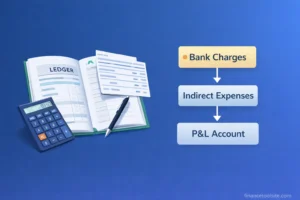
Bank charges are booked under the “Indirect Expenses” group in Tally Prime. The ledger is typically named “Bank Charges” or “Bank Service Charges,” and it sits under Indirect Expenses, which further falls under the Profit & Loss Account on the debit side. This is the standard treatment followed across most businesses in India.
Table of Contents
Why Bank Charges Fall Under Indirect Expenses — The Accounting Logic
This is where many beginners get confused. They know it’s an expense, but they’re unsure whether it should go under Direct Expenses or Indirect Expenses. Let me explain the distinction simply.
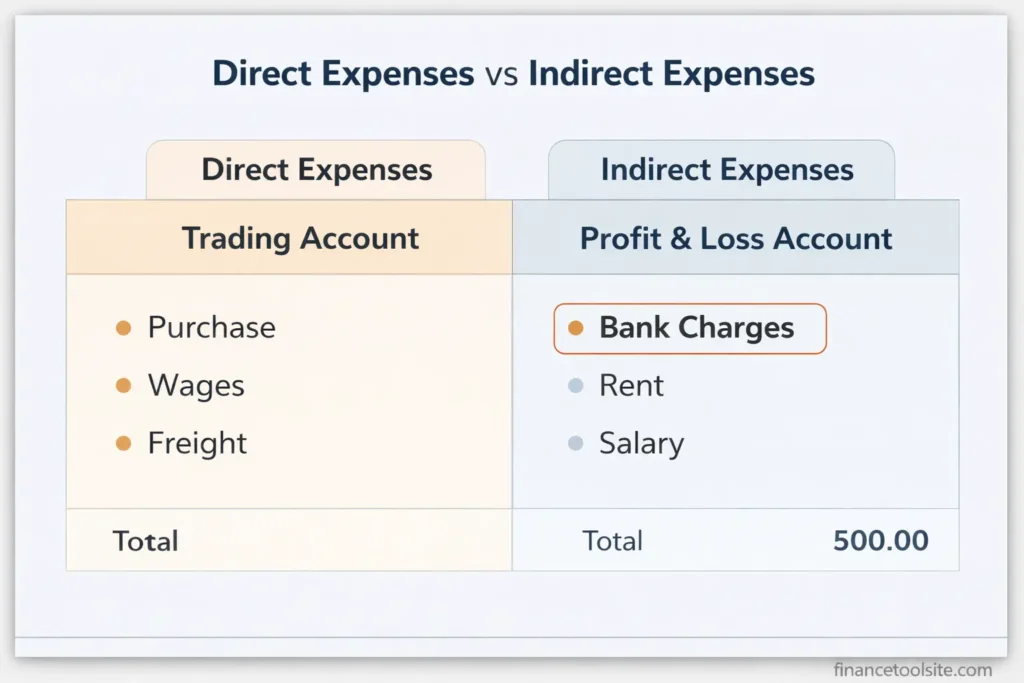
Direct Expenses are those costs that are directly tied to production or the core service delivery — things like raw material, labour, or freight inward. If you remove a direct expense, you literally cannot produce what you’re selling.
Bank charges, on the other hand, are operational or administrative in nature. Whether your company manufactures 100 units or 10,000 units this month, the bank will still charge you ₹500 as account maintenance fees. These charges don’t change based on production volume. They’re part of running the business, not making the product.
That’s precisely why they’re classified as Indirect Expenses — because they relate to the administration and finance side of operations, not the direct manufacturing or trading process.
In accounting terms, Indirect Expenses reduce your net profit and appear in the Profit & Loss Account. When you create a Bank Charges ledger under Indirect Expenses in Tally, the software automatically maps it to the P&L on the debit side, which is exactly where it belongs.
Similarly, other operational costs such as office rent, professional fees, and even certain business insurance premiums are also treated as indirect expenses because they support the business rather than directly contribute to production. If you’re unsure which policies fall under this category, you can read about the different types of business insurance every company should consider for proper financial planning.
For a full list of all ledger groups and where different accounts go, refer to this complete Tally ledger group list — it’s helpful for understanding how Tally’s Chart of Accounts is structured.
Step-by-Step: How to Create Bank Charges Ledger in Tally Prime
Let’s do this practically. These are the exact steps to follow in Tally Prime:
- Open Tally Prime and go to your company.
- Press G (Go To) or navigate using the top menu.
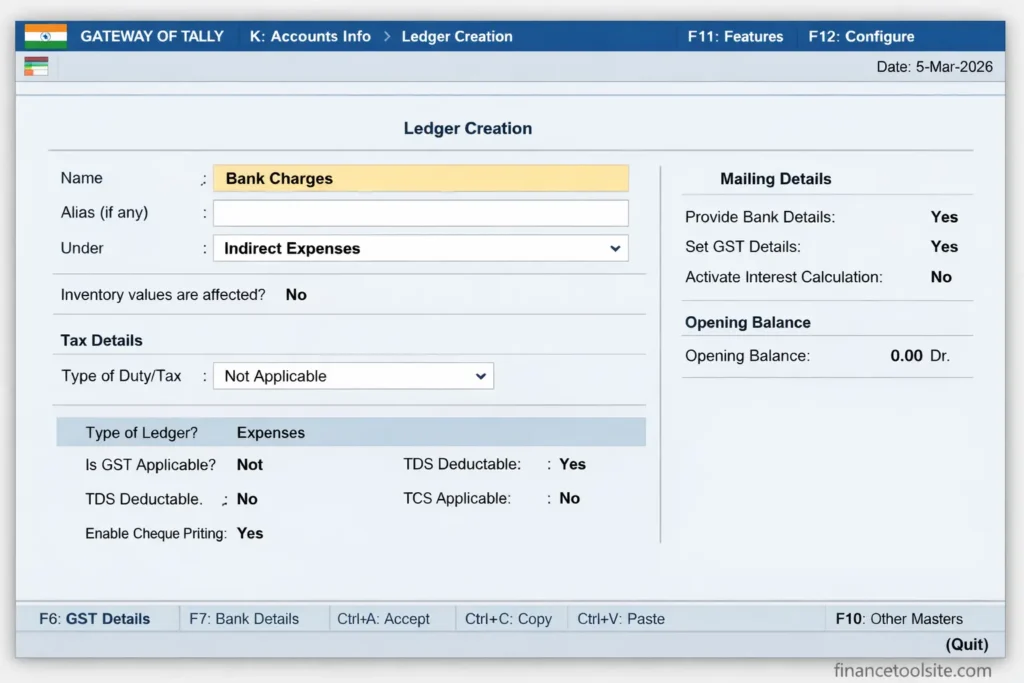
- Go to Create → Ledger (or press Alt+G, then type “Create Ledger”).
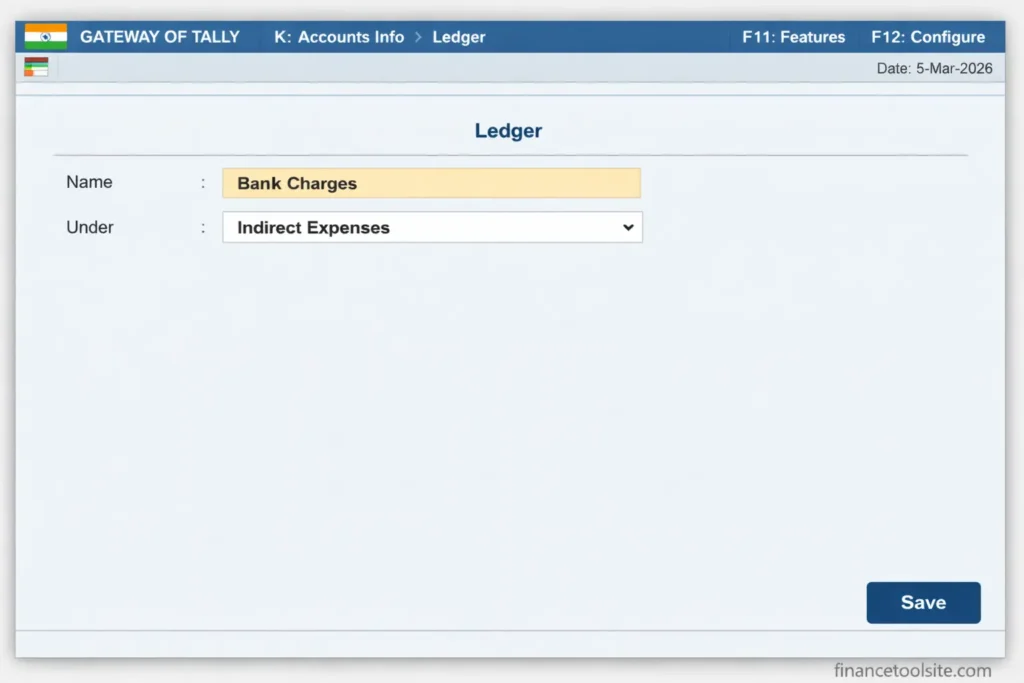
- In the Name field, type: Bank Charges
- In the Under field, select: Indirect Expenses
- Leave the other fields at their default unless you need GST configuration (discussed below).
- Press Ctrl+A or Enter to save the ledger.
That’s it. The ledger is now ready to use in your voucher entries.
One thing to note — if your bank charges attract GST (which is common for services like processing fees or fund transfers), you may need to enable GST on this ledger. In that case, set Is GST Applicable to Yes and configure the HSN/SAC code accordingly. Most basic bank maintenance charges are exempt, but transaction fees often carry 18% GST.
Journal Entry for Bank Charges in Tally
Once the ledger is created, you’ll record bank charges through a Payment Voucher or sometimes a Journal Voucher, depending on how the entry needs to be reflected.
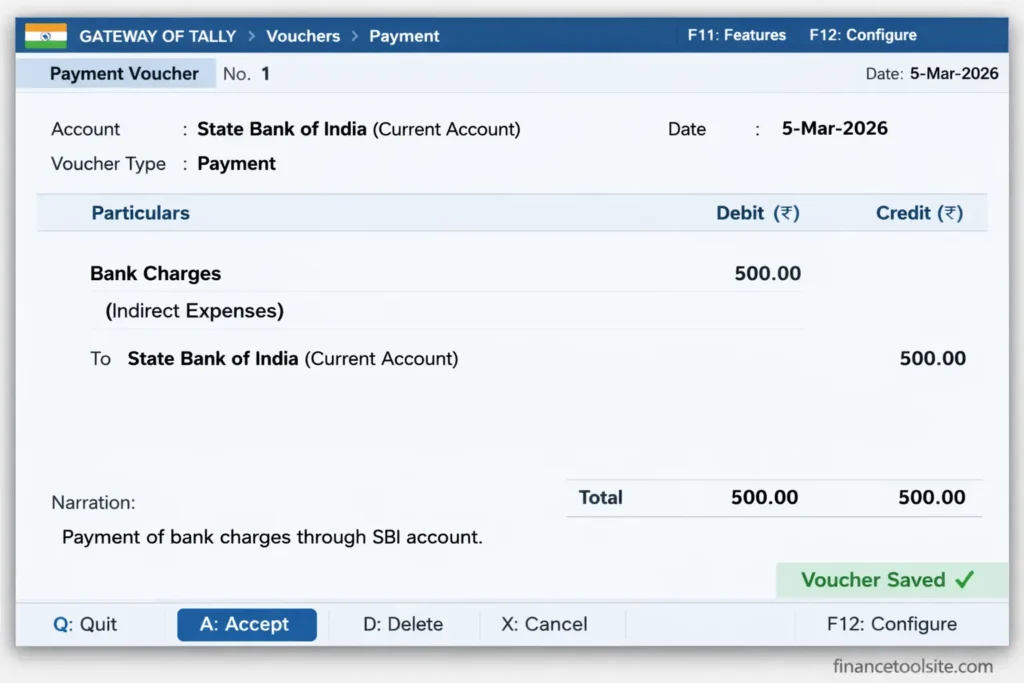
Scenario: Bank deducts ₹500 as quarterly maintenance charges
Entry in Tally (Payment Voucher):
| Particulars | Debit (Dr.) | Credit (Cr.) |
|---|---|---|
| Bank Charges A/c | ₹500 | — |
| To State Bank of India A/c | — | ₹500 |
Accounting Logic: The Bank Charges account is debited because it’s an expense (expenses always increase on the debit side). The Bank Account is credited because money is going out of the bank — your asset is reducing.
In Tally, go to Accounting Vouchers → Payment (F5), select Bank Charges as the debit account, and your bank ledger as the credit account. Enter the amount and narration such as: “Being quarterly maintenance charges deducted by bank.”
Real-World Example Scenario
Ramesh runs a small textile trading firm in Surat. He receives his bank statement at the end of March and notices three separate deductions:
- ₹295 — Annual debit card charges
- ₹118 — NEFT transaction fees (for 4 transactions × ₹29.50)
- ₹59 — SMS alert charges for the quarter
He could book these as three separate entries, or combine them in one voucher:
Combined Entry:
| Particulars | Debit | Credit |
|---|---|---|
| Bank Charges A/c | ₹472 | — |
| To HDFC Bank Current A/c | — | ₹472 |
In Tally, he records this as a single Payment Voucher with narration: “Bank charges for March — card, NEFT, and SMS fees.” Simple. Clean. Correct.
Many small businesses also track their total banking costs separately for budgeting purposes. If you want to improve your overall financial planning and control unnecessary expenses, you can explore some practical money management books in Hindi that help business owners build better financial discipline.
At the same time, it’s important to monitor these charges regularly. You can calculate your total monthly bank charges using this simple bank charges calculator tool to stay on top of recurring deductions and avoid surprises in your bank reconciliation.
Comparison: Indirect Expenses vs Direct Expenses for Bank Charges
| Factor | Direct Expenses | Indirect Expenses |
|---|---|---|
| Linked to production? | Yes | No |
| Changes with output? | Usually yes | Usually no |
| Example | Raw material, freight inward | Bank charges, office rent |
| Where shown in P&L? | Trading Account (debit) | P&L Account (debit) |
| Bank charges here? | ❌ No | ✅ Yes |
Common Mistakes Accountants Make with Bank Charges
1. Creating Bank Charges under Direct Expenses. This is the most frequent error, especially with new accounting staff. It distorts the gross profit figure. Always use Indirect Expenses.
2. Not reconciling bank charges with the bank statement. Many businesses book an estimated amount and never verify the actual charges deducted. This causes BRS (Bank Reconciliation Statement) differences that are hard to trace later.
3. Ignoring GST on bank charges. Banks now charge GST on most service fees. If you’re GST-registered and your bank charges include tax, you may be eligible to claim Input Tax Credit. Missing this is leaving money on the table.
4. Using the wrong voucher type. Some accountants pass bank charges through a Journal Voucher when they should be using a Payment Voucher. Since bank charges reduce the bank balance directly, a Payment Voucher with the bank as the credit account is the correct approach.
5. Lumping all bank charges into one annual entry. It’s better practice to record charges when they actually occur (or at least monthly), so your books reflect the real financial position at each point in time.
FAQ — Bank Charges in Tally
Q1. Bank Charges Under Which Head in Tally?
Bank charges go under Indirect Expenses in Tally Prime. If you’re wondering Bank Charges Under Which Head in Tally, the correct answer is Indirect Expenses, which is mapped to the Profit & Loss Account on the debit side.
Q2. Can I create a sub-group for different types of bank charges in Tally?
Yes, you can. After deciding Bank Charges Under Which Head in Tally, you can organize them further. If you want to track NEFT fees, card fees, and maintenance fees separately, create individual ledgers under Indirect Expenses or create a sub-group called “Bank Charges” under Indirect Expenses and then add sub-ledgers inside it. Both approaches are valid — choose based on how detailed your reporting needs to be.
Q3. Is bank charge a debit or credit entry in Tally?
When recording Bank Charges Under Which Head in Tally, remember that bank charges are always a debit entry because they are an expense. The corresponding credit goes to your Bank Account, since the bank has deducted the amount from your balance.
Q4. Do bank charges attract GST? How to handle it in Tally?
Yes, most bank service charges attract 18% GST. Once you understand Bank Charges Under Which Head in Tally, you should also configure GST correctly. Enable GST on the Bank Charges ledger and use the correct SAC code (998210 for banking and related financial services). Tally will automatically compute the GST portion during voucher entry.
Q5. What is the difference between bank charges and bank interest in Tally?
While searching for Bank Charges Under Which Head in Tally, many users confuse it with bank interest. Bank interest (like overdraft or loan interest) is usually booked under Interest Paid or Finance Charges — still under Indirect Expenses, but in a separate ledger. Bank charges refer to service fees like maintenance, NEFT charges, etc. Keeping them separate improves financial reporting clarity.
Q6. Should bank charges be shown in Trading Account or P&L Account?
If you’re unsure about Bank Charges Under Which Head in Tally, remember they appear in the Profit & Loss Account, not the Trading Account. Trading Account includes only direct costs related to buying and selling goods. Bank charges are administrative expenses and therefore go to P&L.
Q7. What if bank charges are very small — do I still need to book them in Tally?
Yes. Regardless of size, once you know Bank Charges Under Which Head in Tally, you should record them properly. Even ₹50 or ₹100 entries matter for accurate bank reconciliation and yearly financial accuracy.
Q8. Can bank charges be claimed as a business expense for income tax?
Yes. After properly recording Bank Charges Under Which Head in Tally, these charges are fully allowable business expenses under the Income Tax Act. They reduce taxable income, provided they are related to business transactions.
Summary
Bank charges are an Indirect Expense in Tally Prime. You create the ledger under the Indirect Expenses group, record the entry through a Payment Voucher by debiting Bank Charges and crediting your Bank Account, and you’re done. The logic is straightforward: these charges are operational costs, not production costs, so they belong in the P&L Account rather than the Trading Account.
If your bank charges include GST, configure the ledger accordingly and don’t miss out on Input Tax Credit if you’re eligible. And always make it a habit to match your bank charges entries with the actual bank statement — it keeps your books clean and your BRS hassle-free.
For businesses that want tighter control over overall operating expenses, it’s equally important to estimate other recurring costs like vehicle insurance. You can use this practical car insurance premium calculator in Excel to plan and compare policy expenses more effectively.
Disclaimer: This article is for educational purposes only and does not constitute professional accounting advice. For specific accounting or tax decisions, please consult a qualified Chartered Accountant.