
Commission Under Which Group in Tally Prime – Ledger Creation, Journal Entries & Examples
Many beginners get confused while creating a commission ledger in Tally Prime. The common question is commission under which group in Tally. The answer is simple, but it becomes clear only when you understand the basic accounting logic behind commission transactions.
In business accounting, commission can appear in two different situations. Sometimes a business pays commission to an agent or broker for bringing sales, and sometimes it earns commission by helping another company close deals. Because these two transactions have different effects on profit, Tally places them under different ledger groups.
Selecting the wrong group may not stop the entry from being recorded, but it can distort your Profit & Loss statement and make financial analysis confusing. That is why it is important to understand how commission is classified in accounting before creating the ledger in Tally.
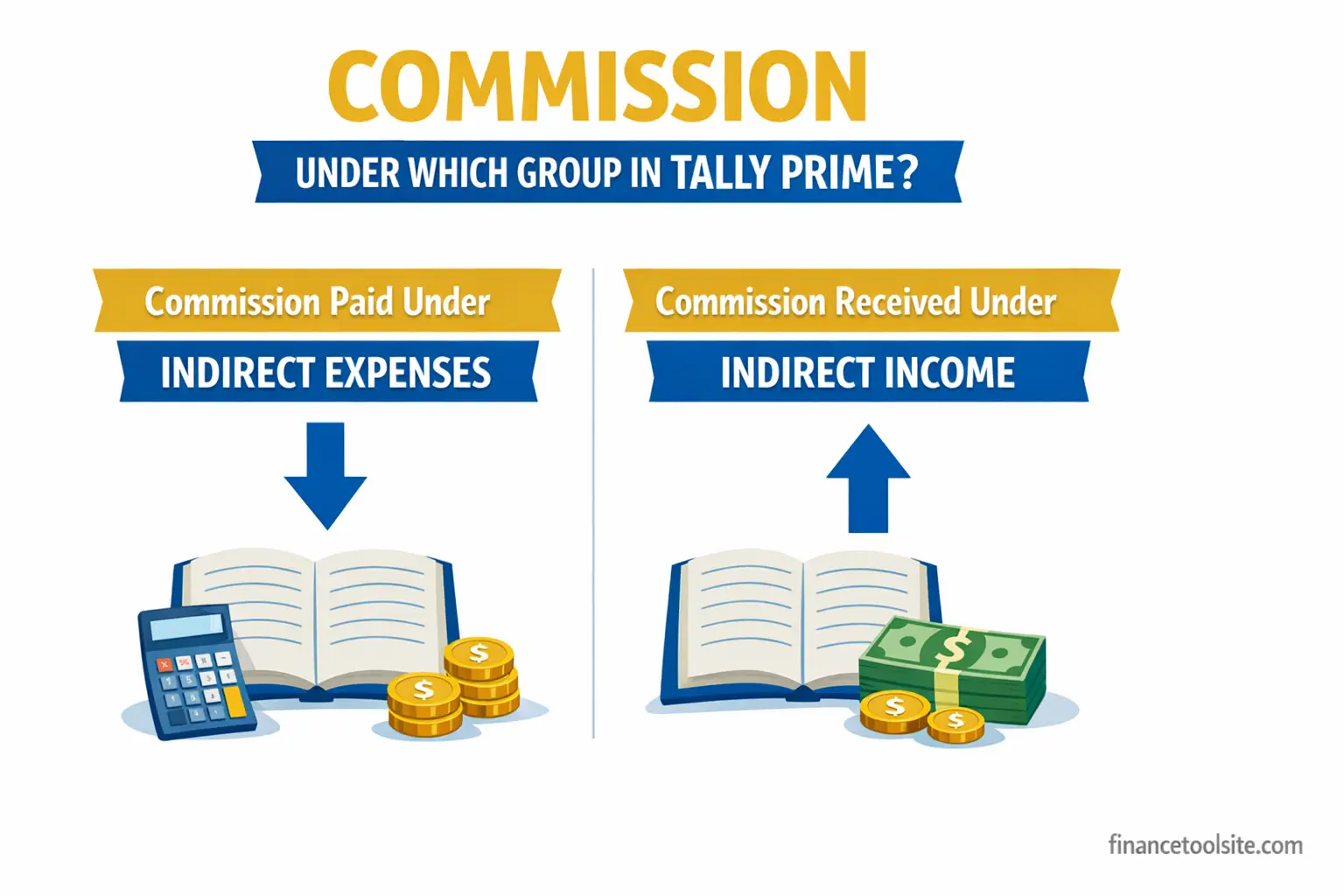
In Tally Prime, commission is recorded under different ledger groups depending on the transaction:
- Commission Paid → Indirect Expenses (expense for the business)
- Commission Received → Indirect Income (income earned by the business)
Commission paid is treated as a business expense, while commission received is treated as income in the Profit & Loss account.
Table of Contents
Commission Under Which Group in Tally Prime – Detailed Explanation
To understand commission under which group in Tally, you must first understand how Tally organises ledgers.
Every ledger in Tally is placed under a group. These groups determine whether the ledger affects the Balance Sheet or the Profit & Loss account.
When you create a ledger, Tally asks you to select the parent group because it needs to know the nature of the transaction — whether it represents income, expense, asset, or liability.
Commission is generally considered a service-based transaction rather than a direct sale or purchase of goods. Businesses pay commission to agents, brokers, or representatives for bringing sales or helping close deals. Similarly, a business may also earn commission when it acts as an intermediary.
Because commission is not directly connected to manufacturing or production activities, it does not fall under direct expenses. Instead, it is categorised under Indirect Expenses when paid and Indirect Income when received.
This classification ensures that the Profit & Loss statement accurately reflects operational costs and income streams.

Commission Paid vs Commission Received in Tally
Many beginners searching commission under which group in Tally Prime often get confused between commission paid and commission received. The accounting treatment for both is different, which is why separate ledgers are always recommended.
Commission Paid
Commission paid refers to the amount a business gives to agents, brokers, or intermediaries who help generate sales or business opportunities. For example, a company may offer a sales representative a percentage of the total sales value as commission.
Since this amount reduces the company’s profit, it is recorded as an expense. In Tally, this type of commission is placed under the Indirect Expenses group.
Commission Received
Commission received is the opposite scenario. In this case, the business itself acts as an agent or intermediary and earns commission from another company for facilitating sales or services.
Because this amount increases the company’s revenue, it is treated as income and recorded under Indirect Income in Tally.
A common mistake beginners make is creating only one ledger named “Commission”. This often leads to incorrect classification in the financial statements. The better practice is to maintain two separate ledgers:
- Commission Paid
- Commission Received
This keeps the accounting records clear and easy to analyse.
Why Commission Comes Under These Groups – Accounting Logic
Understanding why commission comes under these groups in Tally requires a basic knowledge of accounting classification.
Expenses in accounting are divided into two broad categories:
Other common business expenses, like insurance premiums, are also classified under Indirect Expenses in Tally. If you want to understand this in detail, you can read this guide on insurance under which head in Tally.
Direct Expenses
These expenses are directly related to the production of goods or services. Examples include raw materials, factory wages, and freight inward.
Indirect Expenses
These are business expenses that are not directly connected to production but are necessary for running the business. Examples include rent, salaries, electricity, advertisement, and commission paid.
Since commission is generally related to sales promotion or intermediary services rather than production, it is classified as an Indirect Expense when paid.
Similarly, income is also classified into categories such as Direct Income and Indirect Income. Direct income usually comes from the main business activity, like sales revenue. Indirect income includes earnings from secondary sources such as interest, discount received, and commission received.
According to accounting principles recognised under the Companies Act, 2013 and Indian accounting standards, proper classification of income and expenses is essential for accurate financial reporting.
If you want a complete overview of how different ledgers are classified in Tally, you can refer to the complete tally ledger group list to understand the structure in detail.
Step-by-Step: How to Create Commission Ledger in Tally Prime
Once you understand commission under which group in Tally, the next step is creating the ledger correctly in Tally Prime.
Creating Commission Paid Ledger
- Open Tally Prime on your computer.
- Go to Gateway of Tally.
- Select Create and choose Ledger under Accounting Masters.
- In the Name field, type Commission Paid.
- In the Under field, select Indirect Expenses.
- Keep the remaining fields as default unless your accountant advises otherwise.
- Press Ctrl + A to save the ledger.
Creating Commission Received Ledger
- Again go to Gateway of Tally.
- Select Create → Ledger.
- Enter Commission Received in the name field.
- In the Under field, select Indirect Income.
- Save the ledger by pressing Ctrl + A.
After these steps, both ledgers will be ready for use while recording transactions.
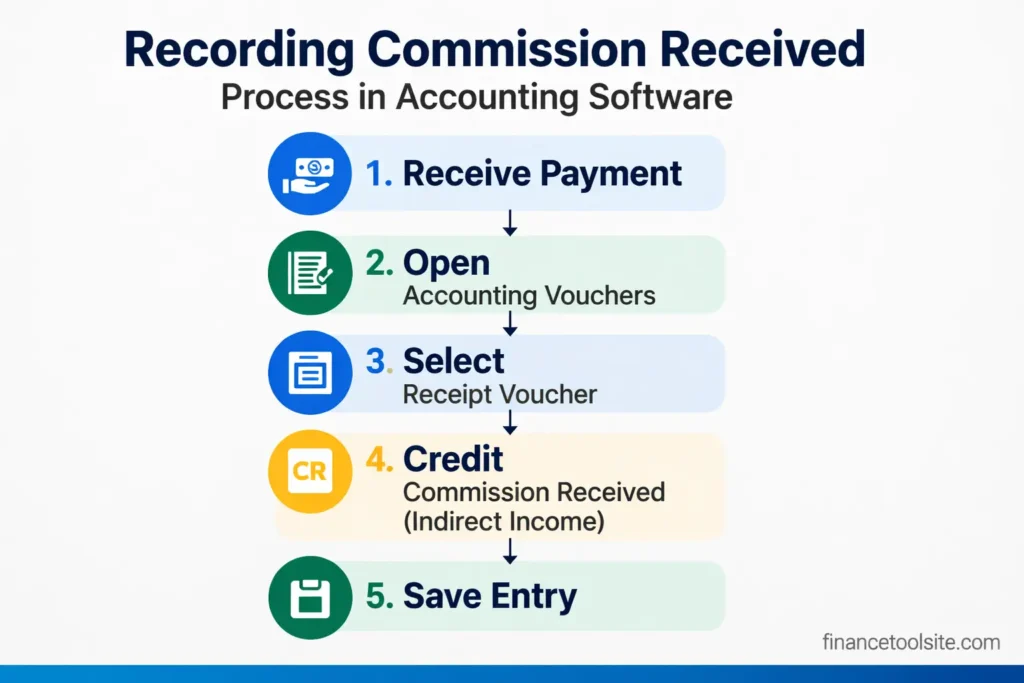
Journal Entry for Commission in Tally
After creating the ledgers, the next step is recording the actual transaction using the correct voucher entry.
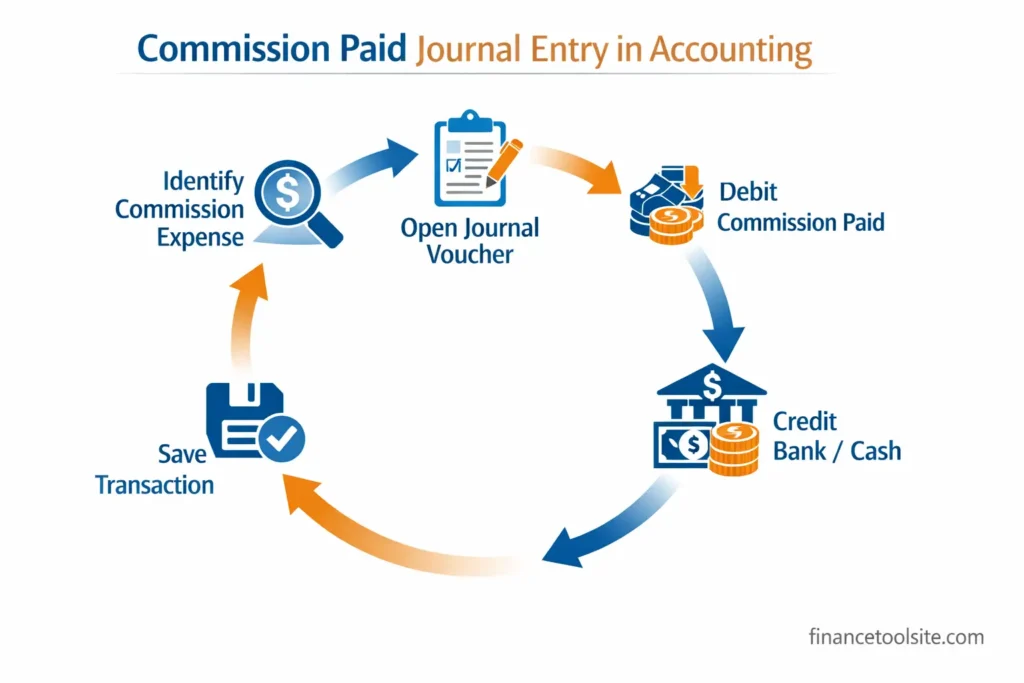
Scenario 1 – Commission Paid
Suppose your business pays ₹5,000 commission to a sales agent.
Accounting Entry:
Commission Paid A/c Dr ₹5,000
  To Bank A/c    ₹5,000
This entry records the payment as an expense and reduces the bank balance.
In Tally Prime, this transaction can be recorded through a Payment Voucher (F5) if the payment is made through cash or bank.
Scenario 2 – Commission Received
Now consider a situation where your business earns ₹3,500 commission from another company.
Accounting Entry:
Bank A/c Dr ₹3,500
  To Commission Received A/c ₹3,500
This entry records commission as income and increases the bank balance.
In Tally Prime, this transaction can be recorded using a Receipt Voucher (F6).
Practical Business Example
To better understand commission under which group in Tally, consider a practical example.
Ramesh owns an electronics distribution business. He works with several sales agents who bring orders from retailers. For every order they bring, Ramesh pays them a commission of 4%.
During one month, the total sales generated by the agents amount to ₹2,00,000. Based on the commission agreement, Ramesh has to pay ₹8,000 as commission.
The accountant creates a ledger called Commission Paid under Indirect Expenses in Tally and records the payment as follows:
Commission Paid A/c Dr ₹8,000
  To Bank A/c   ₹8,000
This expense appears in the Profit & Loss account and reduces the net profit for the month.
At the same time, Ramesh also works as a local sales representative for another company and earns ₹4,500 as commission.
The entry recorded in Tally is:
Bank A/c Dr ₹4,500
  To Commission Received A/c ₹4,500
This amount appears under Indirect Income in the Profit & Loss account.
Businesses like Ramesh’s often manage multiple financial risks while working with distributors and agents. To protect against unexpected losses, many companies also use different types of business insurance depending on their industry and operations.
Many small businesses also track their total banking costs separately for budgeting. You can calculate your total monthly bank charges using this simple online tool.
For example, businesses that maintain company vehicles often estimate their insurance expenses in advance. Tools like this car insurance premium calculator Excel sheet can help calculate approximate insurance costs.
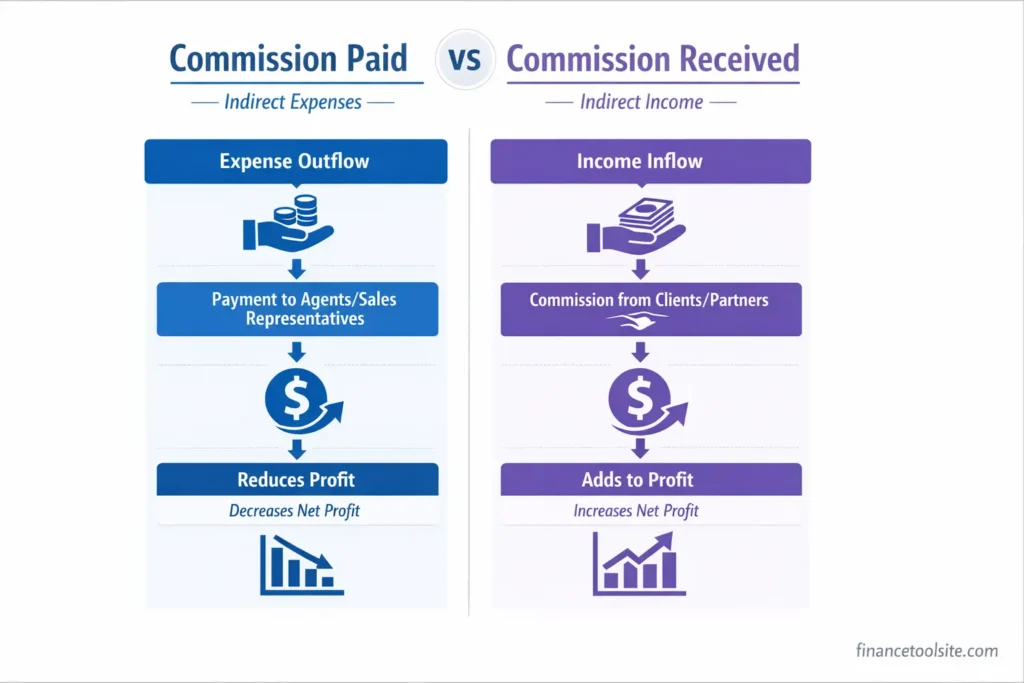
Comparison Table: Commission Paid vs Commission Received
| Feature | Commission Paid | Commission Received |
|---|---|---|
| Nature | Expense | Income |
| Effect on Profit | Reduces profit | Increases profit |
| Ledger Group in Tally | Indirect Expenses | Indirect Income |
| Voucher Type | Payment Voucher | Receipt Voucher |
| P&L Placement | Expense side | Income side |
| TDS Applicability | May apply under Section 194H | May be deducted at source |
According to the Income Tax Department of India, commission payments exceeding a specified threshold may be subject to TDS under Section 194H. Businesses should keep this in mind while recording commission transactions.
Common Mistakes Beginners Make in Tally
When learning commission under which group in Tally, beginners often make several mistakes.
One common mistake is creating a single ledger called “Commission” for both income and expense transactions. This can distort financial reports.
Another mistake is placing commission under Direct Expenses, which is usually incorrect unless it directly relates to purchase transactions in specific industries.
Some users also record every commission transaction using Journal Vouchers, even when payments are made through cash or bank. In such cases, Payment or Receipt Vouchers should be used instead.
Another important point many small businesses overlook is TDS applicability. Commission payments exceeding the prescribed limit require TDS deduction, and failing to record this correctly may create problems during tax filing.
A similar confusion also happens with bank charges in Tally, where beginners are unsure which ledger group should be used. If you want to understand the correct classification, you can read this guide on bank charges under which head in Tally.
Frequently Asked Questions (FAQ)
Q1. Commission under which group in Tally Prime?
Commission paid is recorded under Indirect Expenses, while commission received is recorded under Indirect Income.
Q2. Commission under which group in Tally with example?
If a company pays ₹5,000 to a sales agent, the ledger “Commission Paid” is created under Indirect Expenses. If the company earns ₹3,000 commission, it is recorded under Indirect Income.
Q3. Which ledger comes under which group in Tally?
Each ledger in Tally is classified under a parent group such as Capital Account, Sundry Debtors, Indirect Expenses, Indirect Income, or Bank Accounts depending on its nature.
Q4. Salary under which head in Tally?
Salary is usually recorded under Indirect Expenses because it is a cost of running the business rather than a direct production expense.
Q5. Bills receivable under which group in Tally?
Bills Receivable is placed under the Bills Receivable group, which is part of Current Assets in Tally.
Q6. Commission under which group in Tally ERP 9?
The classification remains the same in Tally ERP 9. Commission Paid goes under Indirect Expenses and Commission Received goes under Indirect Income.
Q7. Is there a Tally under the group list PDF available?
Tally Solutions provides official documentation and help files within the software itself. Press F1 inside Tally for built-in help. You can also visit Tally’s official help site for updated references.
Q8. Does commission attract GST in India?
Yes. Commission services are generally taxable under GST at the applicable rate, typically 18%, depending on the type of service.
Summary
Understanding commission under which group in Tally is essential for maintaining accurate accounting records.
Commission paid to agents or brokers should always be recorded under Indirect Expenses, while commission earned by the business should be placed under Indirect Income. Creating separate ledgers, using the correct voucher type, and checking tax rules such as TDS applicability ensures that your books remain accurate and audit-friendly.
Proper classification not only helps maintain clean financial statements but also makes analysing business profitability much easier.
Disclaimer: This article is for educational purposes only and does not constitute professional accounting advice. For specific tax or accounting guidance, please consult a qualified Chartered Accountant.
2 thoughts on “Commission Under Which Group in Tally? 90% Beginners Choose WRONG!”