

If you have just started using Tally Prime and are wondering insurance premium under which head in Tally, the correct accounting treatment is simple.
Insurance premium is recorded under the Indirect Expenses group in Tally.
You need to create a ledger called “Insurance Premium” and place it under Indirect Expenses.
Insurance premium is treated as an indirect expense because it protects the business rather than directly contributing to production or sales. These expenses are general operating costs and therefore appear on the Expenses side of the Profit & Loss Account in Tally.
This classification applies to most types of business insurance, such as:
- Fire insurance
- Vehicle insurance
- Office or shop insurance
- Stock or goods insurance
- General business insurance
Table of Contents
Insurance Premium in Tally
Insurance premium in Tally Prime is recorded under the Indirect Expenses group.
Create a ledger named Insurance Premium under Indirect Expenses, and record the payment using a Payment Voucher. This treatment is used for most business insurance policies such as fire insurance, vehicle insurance, office insurance, and stock insurance.
| Item | Accounting Treatment |
|---|---|
| Ledger Name | Insurance Premium |
| Group in Tally | Indirect Expenses |
| Voucher Type | Payment Voucher |
| Appears In | Profit & Loss Account (Expenses Side) |
Note: If the insurance policy is a personal life insurance policy of the proprietor, it is usually recorded as Drawings rather than a business expense.
Insurance Premium Under Which Head in Tally
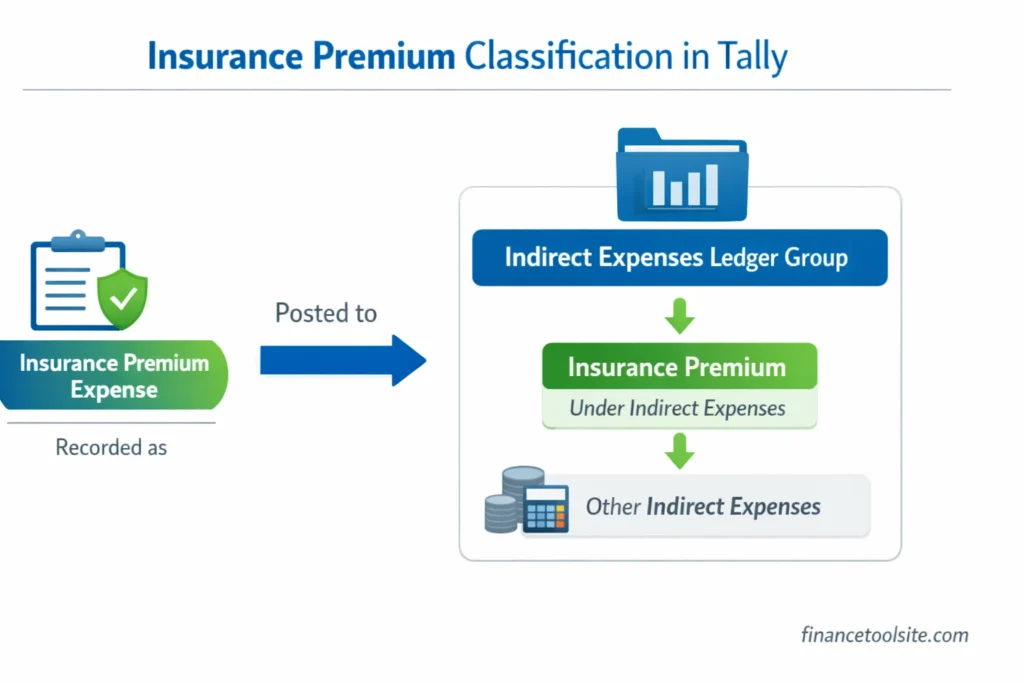
In Tally Prime, every ledger must be placed under a specific accounting group. When recording insurance payments, the correct classification is Indirect Expenses.
Insurance premium in Tally is recorded under the Indirect Expenses group because it is a business overhead cost. It protects the business but is not directly related to manufacturing or production, which is why it is treated as an indirect expense.
For example, if a business pays insurance for:
- Fire insurance for a warehouse
- Vehicle insurance for a company car
- Shop or office insurance
- Stock or goods insurance
all these payments are considered general business expenses. In accounting reports, they reduce the business profit and appear on the Expenses side of the Profit & Loss Account under Indirect Expenses.
If you want to understand how other expenses are classified, you can also review the complete Tally ledger group list, which shows where each type of ledger is placed within the accounting structure.
Accounting Classification in Tally
| Item | Details |
|---|---|
| Ledger Name | Insurance Premium |
| Group in Tally | Indirect Expenses |
| Appears In | Profit & Loss Account (Expenses Side) |
This treatment is also consistent with accounting guidance issued by the Institute of Chartered Accountants of India (ICAI), which classifies business insurance premiums as revenue expenditure because they are recurring costs incurred to protect normal business operations.
Why Insurance Premium Comes Under Indirect Expenses
Many beginners get confused about why insurance premium is recorded under Indirect Expenses in Tally. The reason becomes clear when you understand how expenses are classified in accounting.
In basic accounting, expenses are broadly divided into two categories: Direct Expenses and Indirect Expenses.
Direct Expenses
Direct expenses are costs that are directly related to manufacturing or producing goods. These expenses are necessary to bring a product to a saleable condition.
Common examples include:
- Raw materials
- Factory labour wages
- Factory rent
- Freight inward
- Manufacturing power and fuel
These costs are usually recorded under Direct Expenses and affect the cost of production.
Indirect Expenses
Indirect expenses are the costs required to run and manage the overall business, but they are not directly connected to production.
Examples include:
- Office rent
- Telephone and internet bills
- Office stationery
- Administrative salaries
- Insurance premiums
Why Insurance Premium Is an Indirect Expense
Insurance premiums are paid to protect the business from financial risks, such as damage to property, loss of stock, or accidents involving company vehicles.
For example, a business may pay insurance for:
- Office or shop building
- Business vehicles
- Inventory or stock
- Employees or workplace liabilities
These payments do not contribute directly to manufacturing or purchasing goods. Instead, they protect the business from unexpected losses. Because of this, insurance premium is treated as a general operating expense and is classified under Indirect Expenses in accounting.
This treatment is consistent with standard accounting practices followed in India and guidance issued by the Institute of Chartered Accountants of India (ICAI).
Additionally, the Income Tax Department of India allows insurance premiums paid for business purposes to be claimed as a deductible business expense under the Income Tax Act, 1961, which further confirms that it is considered a normal operating expense.
Note: If an insurance policy is taken on the personal life of the proprietor or partners, it is usually not treated as a business expense. In such cases, the payment may be recorded as Drawings or a capital-related transaction, depending on the situation. For the correct treatment, refer to your guide on life insurance under which head in Tally.
Ledger Head Table for Different Insurance Situations
Different types of insurance can have slightly different accounting treatment depending on the purpose of the policy. The table below shows the recommended ledger name, group in Tally, and where the entry appears in financial statements.
| Type of Insurance | Suggested Ledger Name | Group in Tally | Appears In |
|---|---|---|---|
| Fire Insurance | Insurance Premium | Indirect Expenses | Profit & Loss – Expenses |
| Vehicle Insurance (Business) | Insurance Premium | Indirect Expenses | Profit & Loss – Expenses |
| Stock / Goods Insurance | Insurance Premium | Indirect Expenses | Profit & Loss – Expenses |
| Office / Shop Insurance | Insurance Premium | Indirect Expenses | Profit & Loss – Expenses |
| Employee Group Insurance | Insurance Premium | Indirect Expenses | Profit & Loss – Expenses |
| Life Insurance (Proprietor) | Drawings / Insurance Premium | Capital / Indirect Expenses | Balance Sheet / P&L |
| Prepaid Insurance (Advance Payment) | Prepaid Insurance | Current Assets | Balance Sheet |
| Marine / Export Insurance | Insurance Premium | Direct Expenses* | Profit & Loss – Direct Expenses |
* Note: Marine insurance on imported or exported goods may sometimes be classified as Direct Expenses, because it relates directly to the purchase or transportation of goods. However, many businesses still record it under Indirect Expenses for simplicity. For the correct treatment in your case, consult a qualified Chartered Accountant.
If you want to understand how other expenses are classified in accounting software like Tally Prime, you can also check related guides such as:
These examples help you understand how different expenses are grouped within the accounting structure.
How to Record Insurance Premium in Tally Prime (Step-by-Step)

Recording an insurance premium in Tally Prime involves two simple steps:
- Creating the Insurance Premium ledger and
- Recording the payment voucher.
Follow the steps below.
Step 1 — Create the Insurance Premium Ledger
First, you need to create a ledger where all insurance expenses will be recorded.
Path in Tally Prime:
Gateway of Tally → Accounts Info → Ledgers → Create
Now enter the following details:
- Name: Insurance Premium
- Under: Indirect Expenses
- Inventory values affected: No
After entering the details, press Ctrl + A to save the ledger.
Quick Shortcut: Press Alt + G → Create Master → Ledger to open the ledger creation screen directly.
Step 2 — Record Insurance Payment in a Payment Voucher
Once the ledger is created, you can record the insurance premium payment.
Path in Tally Prime:
Gateway of Tally → Vouchers → Payment (F5)
Enter the voucher details as follows:
- Debit Ledger: Insurance Premium
- Amount: Enter the premium amount (for example ₹12,000)
- Credit Ledger: Cash / Bank (depending on how the payment was made)
- Narration: Example — “Fire insurance premium paid for FY 2026-27”
After entering the details, press Enter and save the voucher.
This entry will automatically record the expense in the Profit & Loss Account under Indirect Expenses.
Important Accounting Tip
Always keep a copy of the insurance policy document and payment receipt for accounting and audit purposes. In India, insurance companies and policies are regulated by the Insurance Regulatory and Development Authority of India (IRDAI), so maintaining proper documentation helps ensure accurate bookkeeping and compliance.
Journal Entry for Insurance Premium in Tally
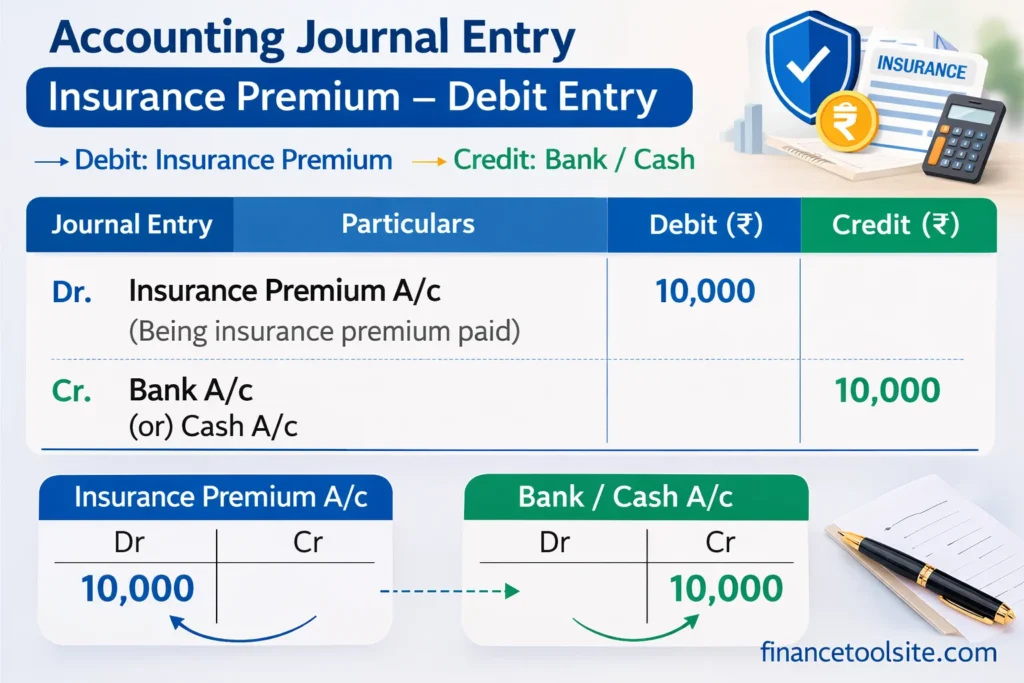
Whenever a business pays an insurance premium, the transaction must be recorded as an expense in the accounts. In bookkeeping, insurance is treated as an operating expense, so the Insurance Premium account is debited, while the Cash or Bank account is credited because money leaves the business.
Standard Accounting Entry
| Account | Debit / Credit | Amount | Purpose |
|---|---|---|---|
| Insurance Premium A/c | Debit | ₹12,000 | Records the insurance expense |
| Bank / Cash A/c | Credit | ₹12,000 | Payment made from business funds |
Why This Entry Is Passed
Insurance premium represents the cost paid by the business to protect its assets or operations. In accounting and in Tally Prime, when recording insurance premium under which head in Tally, it is treated as an Indirect Expense, so the Insurance Premium account is debited because expenses increase on the debit side.
At the same time, the bank or cash balance decreases because the premium is paid to the insurance company, so the Bank or Cash account is credited while recording the insurance premium entry in Tally.
How the Entry Is Recorded in Tally
In Tally Prime, you usually record this transaction using a Payment Voucher instead of manually passing a journal entry.
Typical voucher structure:
- Debit: Insurance Premium
- Credit: Bank / Cash
- Voucher Type: Payment Voucher
Once the voucher is saved, the expense automatically appears in the Profit & Loss Account under Indirect Expenses.
Accounting Principle Behind This Entry
This transaction follows the double-entry accounting system, where every financial transaction affects at least two accounts — one debit and one credit. The same principle is applied when recording insurance premium under which head in Tally, ensuring that the Insurance Premium account is debited and the Bank or Cash account is credited. This keeps the accounting records balanced and accurately reflects the financial position of the business.
Prepaid Insurance Premium in Tally
Sometimes a business pays an insurance premium in advance — meaning the insurance period covers a future financial year. For example, you pay ₹24,000 in February 2025 for a policy covering March 2025 to February 2026.
In this case, a portion of the payment belongs to the current financial year and the remaining portion is a Prepaid Expense (an asset — not yet consumed).
How to Create Prepaid Insurance Ledger in Tally Prime
- Go to Gateway of Tally → Accounts Info → Ledgers → Create
- Name: Prepaid Insurance Premium
- Under: Current Assets
- Save the ledger
Journal Entry for Prepaid Insurance
Assume insurance premium paid: ₹24,000 (February 2025). Of this, ₹22,000 relates to the next financial year.
| Account | Debit / Credit | Amount |
| Insurance Premium A/c | Debit | ₹2,000 (current year portion) |
| Prepaid Insurance A/c | Debit | ₹22,000 (advance for next year) |
| Bank A/c | Credit | ₹24,000 |
At the start of the next financial year, you reverse the prepaid entry by debiting Insurance Premium and crediting Prepaid Insurance.
For a broader understanding of how insurance accounts are classified in Tally, also refer to insurance under which head in Tally.
Practical Example of Insurance Premium Entry in Tally
Business Name: Sharma Trading Co., Delhi
Scenario: The business pays ₹18,000 by bank transfer on 1 April 2025 as annual fire insurance premium for their godown.
Step 1 — Ledger already exists: Insurance Premium → Indirect Expenses
Step 2 — Payment Voucher Entry in Tally Prime
| Field | Value |
| Voucher Type | Payment |
| Date | 01-04-2025 |
| Debit Ledger | Insurance Premium |
| Amount | ₹18,000 |
| Credit Ledger | HDFC Bank A/c |
| Narration | Annual fire insurance premium paid for godown — Policy No. XYZ123 |
Effect on Accounts: Insurance Premium account increases by ₹18,000 (expense). Bank balance decreases by ₹18,000. This expense will appear in the Profit & Loss account for FY 2025-26 under Indirect Expenses.
Similar to how drawings are treated separately from business expenses — see drawings comes under which head in Tally — insurance is purely a business expense and should not be mixed with personal expenses of the owner.
Common Mistakes Beginners Make When Recording Insurance in Tally
1. Placing Insurance Under Direct Expenses Instead of Indirect Expenses
Most beginners place insurance under Direct Expenses. This is wrong for general business insurance. Direct Expenses are for production-related costs. Insurance is an overhead — it must go under Indirect Expenses.
2. Mixing Life Insurance With Business Insurance
If a proprietor pays a life insurance premium from the business account for their personal policy, that is not a business expense. It should be recorded as Drawings, not as Insurance Premium expense. Read life insurance under which head in Tally for the correct treatment.
3. Forgetting to Separate Prepaid Insurance
When an annual insurance policy spans two financial years, beginners often expense the full amount in the current year. This overstates expenses for the current year. The advance portion must be shown as Prepaid Insurance under Current Assets.
4. Not Keeping Policy Details in Narration
Always add policy number and insurance period in the narration field of the voucher. This makes audit and verification much easier.
5. Using Cash Voucher Instead of Payment Voucher for Bank Payments
If the insurance was paid through a bank transfer or cheque, use a Payment Voucher and select the bank ledger — not the Cash Voucher. This keeps your bank reconciliation accurate.
FAQ — Insurance Premium Under Which Head in Tally
1. Insurance premium under which head in Tally Prime?
In Tally Prime, insurance premium is usually recorded under Indirect Expenses. You can create a ledger named Insurance Premium and place it under the Indirect Expenses group. This expense will appear on the Profit & Loss Account of the business.
2. Insurance premium under which head in Tally ERP?
In Tally ERP 9, the accounting treatment is the same as in Tally Prime. Insurance premium is recorded under Indirect Expenses, and the payment is entered using a Payment Voucher. The expense is then reflected in the Profit & Loss account.
3. Insurance premium is direct expense or indirect expense?
For most businesses, insurance premium is treated as an Indirect Expense because it is not directly related to manufacturing or production. Instead, it protects business assets such as buildings, stock, or vehicles, making it a general operating expense.
4. Life insurance premium under which head in Tally?
If the life insurance policy belongs to the proprietor or partner personally, it is generally recorded as Drawings instead of a business expense. However, insurance taken for employees may be recorded under Indirect Expenses.
5. Which ledger comes under which group in Tally?
In Tally Prime, every ledger must be placed under a specific accounting group. For example, Insurance Premium comes under Indirect Expenses, while Prepaid Insurance is placed under Current Assets. Correct grouping ensures accurate financial reports.
6. What is the group for advance insurance payment in Tally?
Advance insurance payment is recorded as Prepaid Insurance under Current Assets. This is because the payment relates to a future period and is treated as an asset until the expense is recognized in the Profit & Loss account.
Summary
To quickly summarise: if you are wondering insurance premium under which head in Tally, it is recorded under the Indirect Expenses group in Tally Prime. Create a ledger named “Insurance Premium” under Indirect Expenses, and record payments using a Payment Voucher. If any portion relates to a future period, separate it as Prepaid Insurance under Current Assets.
Keeping your insurance accounting clean and correctly categorised helps you get accurate profit reports, simplifies tax filing, and makes financial audits much smoother.
If you are also working on other expense ledger classifications, explore the complete Tally ledger group list for a full reference.
| Disclaimer: This article is for educational purposes only and does not constitute professional accounting advice. Please consult a qualified Chartered Accountant for specific advice on your business. |